It's wonderful when your spouse really surprises you - Muna had always enjoyed the ride on a horse (or was it a donkey) into the magnificent, enchanting city of Petra in Jordan many years ago, so when I saw an advertisement for horse riding in the Golan Heights, I was truly delighted when Muna was keen to try. With our good friends Mark and Carolina, we headed out on a lovely warm winter day in early January.
 The ranch Ramot was truly professional and catered for those who had ridden before, and those who had not. The horses were in excellent shape and after a thorough safety presentation, it was time for the horse to meet Muna.
 This is no ride for those who want to canter - it was a circuit overlooking the Sea of Galilee (Kinneret) over some very rough terrain- the horses finding their way amongst the many stones.
 A little Jack Russell terrier accompanied us all the way and really knew its way around horses.
 The path at the start of the ride was the time for learning how to start, turn, make it go faster and stop our horses. After that the terrain became very hilly and rough - a great ride.
Muna is a natural when it comes to riding - even though these were big horses. A Russian mother and her daughters accompanied us on the ride.
 The horses are sure footed, even though we were often on the sides of really steep hills - they know their way. We saw lots of wild life but I found out it is really hard to take photos when you are riding a horse! Birds and a fox racing down the hill were a thrill to see.
 This is a genuine rock garden! Basalt boulders everywhere. Tough on the shoes of the horses.
 Half way around we looked east to the meeting of several water courses, including th "El Al" river - the name of the Israeli carier. Magnificent views from this vantage point.
 Archeologists have confirmed that these rocks are from a civilisation that lived here thousands of years ago. Easy to find building materials. Not sure what they ate and how they survived the cold winter nights.
 Cattle country - they were not amused when the Jack Russell sorted them out and moved them on out of the way of the horses.
 Cyclamens flower in winter, well it is really spring, as we had the most mild but driest Janaury in the past 80 years. Lovely to see these. In a month or so the Golan Heights will be ablaze with wild flowers.
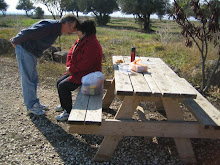
 A great lunch after all that exertion - well by the horses anyway.
 Then off to an area we have not yet visited - the north-eastern part of Israel near the border of Syria. These are the Golan Heights.
 At one point we were right on the border of Syria
 Even Allan could work out this was a no-go area!
 and this area is patrolled by the United Nations who passed by in one of their vehicles.
 To our amazement we came across a wind farm - quite old by the look of the turbines.
 We really felt the spectre of war - this area saw intense fighting during the 1967 war. Remnants remain.
 And more - not sure if they were left as a reminder of the conquest.
 We really felt the high security in this area, as we looked out on Syria, the first glimpse for Allan.
 Soldiers no doubt sought shelter and fought in these buildings - they are pock-marked with bullet holes so many died as well.
 Areas are still littered with mines and warning signs show you where to venture not.
 Further down Jordan borders with Israel and it is a very hilly desolate border - so different from the rich farmland inside Syria a few kilometres north. The road twists and turns and new villages in northern Jordan suddenly appear.
 There once was a border crossing bridge - partly destroyed in the war. Note the hilly terrain.
 As we appraoched the southern end of the Sea of Galiliee the sun suddenly set, on what was an amazing day in the Golan Heights.
 Being winter time, we sometimes get a few really clear days in Haifa. When that happens we can clearly see Mt. Hermon to the north - this is located in Lebanon and is snow capped in winter. A few days this year it was clearly visible from the window of the Office where Allan works. It is the source of water for the river Jordan, not that much actually gets to flow there these days.
 The Baha'i World Centre is a lot like some mining towns - people coming and going all the time as staff from over 70 countries come and serve for periods of typically 1 year to 5 years. An Aussie lass from Sydney - Zoha Stafford - served with Allan for the last six months and brought a lot of capability and joy to the Office - it was so sad to say farewell Zoha! All the best with work and your studies.

 The horses are sure footed, even though we were often on the sides of really steep hills - they know their way. We saw lots of wild life but I found out it is really hard to take photos when you are riding a horse! Birds and a fox racing down the hill were a thrill to see.
 This is a genuine rock garden! Basalt boulders everywhere. Tough on the shoes of the horses.
 Half way around we looked east to the meeting of several water courses, including th "El Al" river - the name of the Israeli carier. Magnificent views from this vantage point.Archeologists have confirmed that these rocks are from a civilisation that lived here thousands of years ago. Easy to find building materials. Not sure what they ate and how they survived the cold winter nights.
 Cattle country - they were not amused when the Jack Russell sorted them out and moved them on out of the way of the horses.
 Cyclamens flower in winter, well it is really spring, as we had the most mild but driest Janaury in the past 80 years. Lovely to see these. In a month or so the Golan Heights will be ablaze with wild flowers.
 A great lunch after all that exertion - well by the horses anyway.
 Then off to an area we have not yet visited - the north-eastern part of Israel near the border of Syria. These are the Golan Heights.
 At one point we were right on the border of Syria
 Even Allan could work out this was a no-go area!
 and this area is patrolled by the United Nations who passed by in one of their vehicles.
 To our amazement we came across a wind farm - quite old by the look of the turbines.
 We really felt the spectre of war - this area saw intense fighting during the 1967 war. Remnants remain.
 And more - not sure if they were left as a reminder of the conquest.
 We really felt the high security in this area, as we looked out on Syria, the first glimpse for Allan.
 Soldiers no doubt sought shelter and fought in these buildings - they are pock-marked with bullet holes so many died as well.Areas are still littered with mines and warning signs show you where to venture not.
 Further down Jordan borders with Israel and it is a very hilly desolate border - so different from the rich farmland inside Syria a few kilometres north. The road twists and turns and new villages in northern Jordan suddenly appear.
 There once was a border crossing bridge - partly destroyed in the war. Note the hilly terrain.As we appraoched the southern end of the Sea of Galiliee the sun suddenly set, on what was an amazing day in the Golan Heights.Being winter time, we sometimes get a few really clear days in Haifa. When that happens we can clearly see Mt. Hermon to the north - this is located in Lebanon and is snow capped in winter. A few days this year it was clearly visible from the window of the Office where Allan works. It is the source of water for the river Jordan, not that much actually gets to flow there these days.The Baha'i World Centre is a lot like some mining towns - people coming and going all the time as staff from over 70 countries come and serve for periods of typically 1 year to 5 years. An Aussie lass from Sydney - Zoha Stafford - served with Allan for the last six months and brought a lot of capability and joy to the Office - it was so sad to say farewell Zoha! All the best with work and your studies.


 and we had a delightful day at the Sea of Galilee.
 Apart from these dear friends, the real gem of the past few months has been a return to the Negev desert in southern Israel. We scouted out the region in January 2008 and decided that a return visit—this time with 5 additional couples—was well worth it. This map will help identify some of the locations we visited (click on the map to enlarge it).


 Magnificent rock formations abound, as do the ibex.


 and to see a waterfall is even more spectacular, even if it is a trickle after a long dry summer.


 Its good to join the locals
 and participate in local sporting activities
 It had a natural fortification at the back and a clear view of any approaching army from the front.
 No match for the Romans though, who had no great difficulty in occupying the city. With their traditional livelihood gone, the inhabitants of Mamsheet found another way to make a living—raising horses. The residents bred the renowned Arabian horse, which brought great wealth to their city.
 The crater at Mizpe Ramon (Makhtesh) is an unusual formation.
 After the obligatory afternoon tea,